Returns & Replacements
Part of POD returns and replacements
Explaining personalised product return conditions clearly
Explain change-of-mind conditions for personalised POD goods while preserving Australian consumer guarantee remedies.
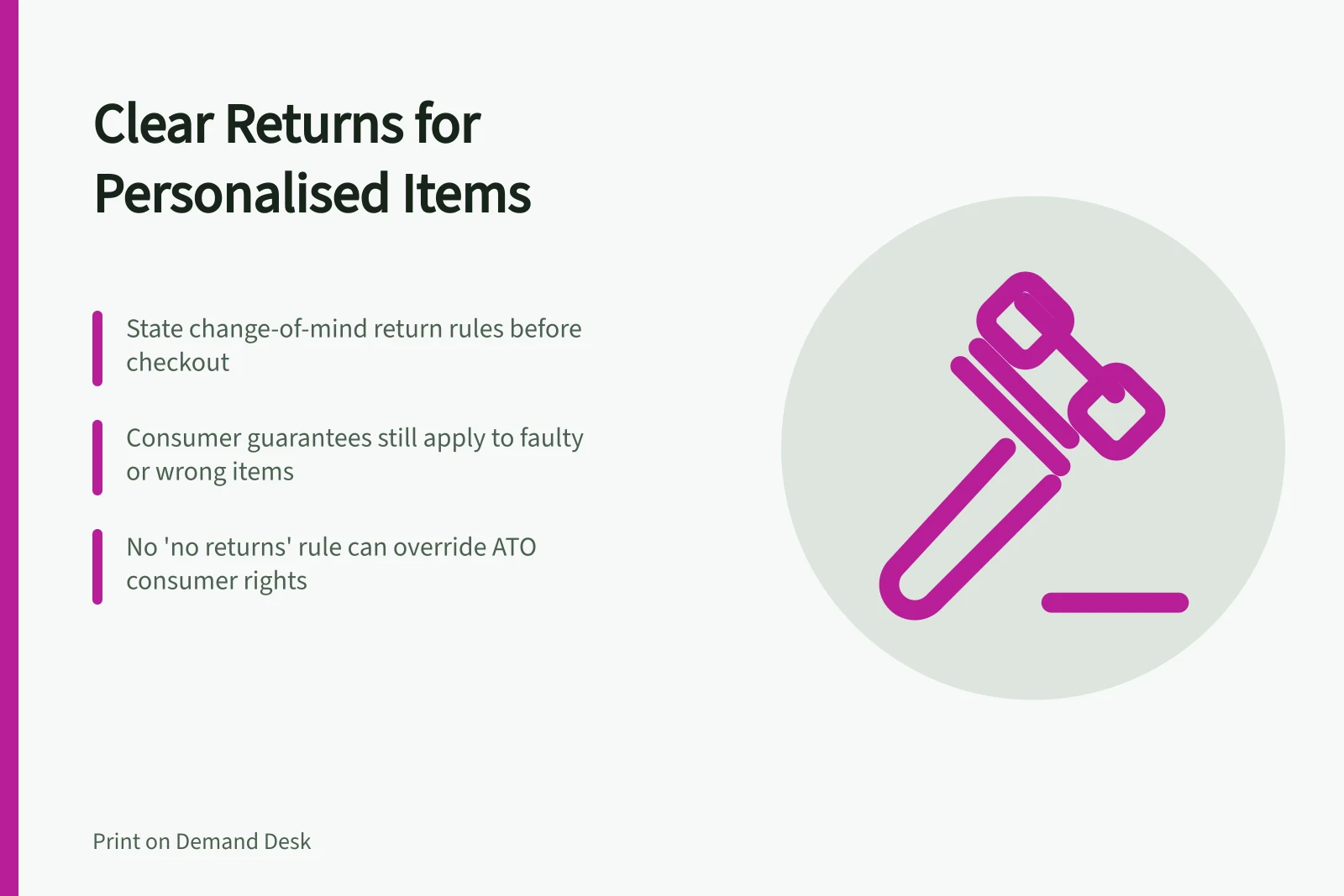
Before checkout, tell buyers whether you allow a change-of-mind return for a personalised item.
Explain separately that applicable Australian consumer guarantee rights still apply when the product has a problem.
A blanket “no returns on personalised goods” statement can mislead buyers about faulty or incorrectly supplied items.
Separate the two return routes
A store can set conditions for voluntary returns when a buyer changes their mind, provided those conditions do not remove or restrict consumer guarantee rights.
If the store offers this type of return, state the eligible products, time limit, item condition and return-postage arrangement. Check that the same conditions appear at checkout and on the returns page.
For a product problem, consumer guarantees still apply. The ACCC says these rights are separate from any warranty a business offers and cannot be taken away by anything a business says or does. Making an item to order does not remove those rights. Do not apply voluntary return exclusions or time limits to a consumer guarantee claim.
Where a store declines voluntary returns for personalised goods, a concise customer-facing clause is:
We do not offer change-of-mind returns for products made with your personalisation. If your item is faulty, was supplied incorrectly or does not meet applicable consumer guarantees, contact us with your order number and a description of the problem. We will assess it and provide the remedy required by Australian consumer law.
For a store that does offer voluntary returns for personalised goods when a buyer changes their mind, a short customer-facing example is: “We accept returns for change of mind on [eligible personalised products] within [time limit] of delivery if the item is unused and in its original condition. You pay return postage. Contact [contact method] to arrange a return.”
Each clause needs a real contact method beside it.
Do not present time limits, restocking or processing fees, or non-refundable delivery fees as absolute conditions for a consumer guarantee remedy.
Explain what the buyer approves
This article covers return conditions only.
For order-capture and proof-approval workflow, see the sibling article on that topic.
Keep the wording consistent
Use the same distinction on the product page, at checkout, in the order confirmation and on the returns page.
Headings such as “Change-of-mind returns” and “Faulty or incorrect items” make the two routes easier to find.
Avoid a lone “final sale” badge that could imply no remedy is available for a faulty item.