Returns & Replacements
Part of POD shipping and delivery expectations
Estimating delivery from production plus transit time
Calculate a POD arrival window without double-counting shipping or mistaking a ship-by date for a delivery date.
To estimate a POD arrival window, add the time before dispatch to transit time for the chosen product, route, shipping service and destination. First check whether the supplier already gives an order-level delivery estimate covering both stages.
Estimate a POD arrival window
- Check the supplier's order-level estimateUse it first if it already covers production and transit.
- Confirm the order is processableCheck that payment, files and approvals are complete.
- Record the production estimateNote the current product or order-level window and its counting rule.
- Add the relevant transit windowUse the selected service and destination.
- Combine into an arrival windowState the start point and keep the estimate current.
Establish when the order can be processed
Confirm the order reached the supplier and that payment, files and approvals are complete. A storefront purchase may precede the supplier's processing start. Record the order-level estimated ship-by date if available.
Check how the supplier counts days and which event starts its production estimate. Do not assume all suppliers count business days or calendar days the same way.
If an order is on hold, ask the supplier how that affects its estimate. Supplier rules can differ.
Add only the relevant transit window
Use the service and destination available for that order. Gelato's estimated delivery dates include fulfilment and shipping. A ship-by date does not, so it still needs a relevant transit estimate to answer when the customer may receive the parcel.
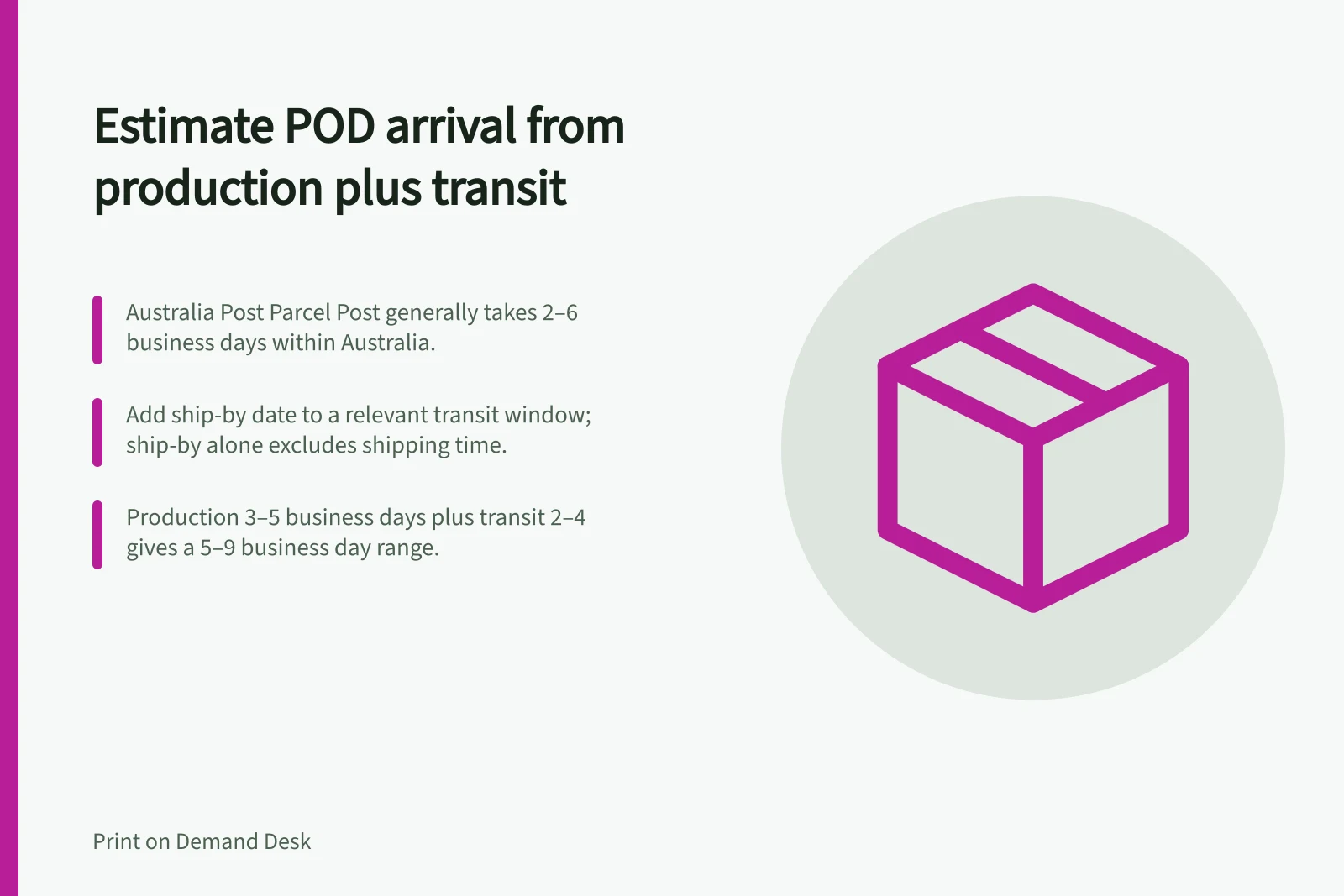
Australia Post's domestic Parcel Post guidance applies only if the parcel uses that service and route. It covers all addresses within Australia and generally takes 2–6 business days.
Record / Check
- Processing start
- When the supplier has a processable order
- Production estimate
- Current product or order-level window and its counting rule
- Transit estimate
- Selected service and destination
- Arrival window
- Combined range, with the start point stated
For illustration, suppose production is estimated at three to five business days and transit at two to four business days. If both stages use the same business-day calendar and follow without a gap, the simple planning range is five to nine business days from the applicable start.
Dispatch cut-offs, weekends, public holidays, holds and different carrier counting rules can move the calendar arrival dates. The sample numbers are not a supplier service level.
Ship-by date vs estimated delivery date
- Ship-by dateDoes not include transit; add a relevant transit estimate to answer when the customer may receive the parcel.
- Estimated delivery dateIncludes fulfilment and shipping.
Check before showing a date
Compare your calculation with the supplier's current order-level delivery estimate. If they differ, check for a changed route or a later update. For separate parcels, estimate each parcel and make clear the whole order is complete only after the last item arrives.
Keep the source and check date for the estimate. Refresh it when the product, supplier, service or destination changes. The ACCC can require businesses to back up claims about their products or services.