Returns & Replacements
Part of POD returns and replacements
Distinguishing print defects from customer preference returns
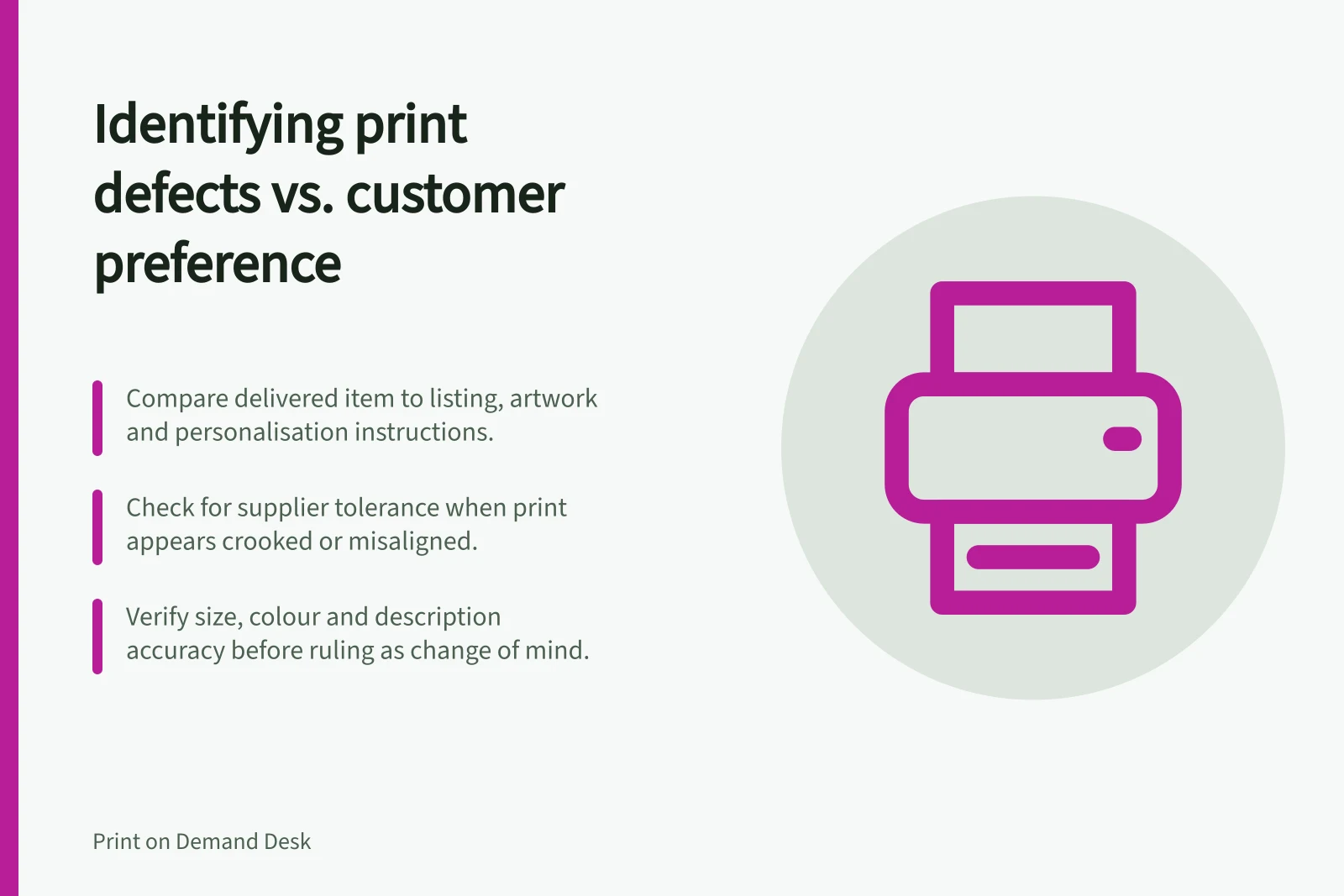
Compare the POD order, listing, approved artwork and delivered item to distinguish a product problem from a preference return.
Compare the delivered item with the order, listing and any approved design before classifying a POD return. An accurately supplied item the customer dislikes is generally a change-of-mind issue. Damage, a wrong variant or a product that does not match its description needs a consumer-guarantee assessment.
Compare the promise with the item
Put the selected variant, listing shown at purchase, final artwork or personalisation instruction, and received item side by side. Ask what the customer believes is wrong. A photo may show a visible difference.
| Report | Compare | Possible finding |
|---|---|---|
| “The print is crooked” | Finished placement, listing image and applicable product guidance | Investigate the actual difference and any supplier tolerance. |
| “I wanted another colour” | Checkout choice, delivered colour and listing | A correctly supplied choice may be preference; a wrong item or inaccurate description is different. |
| “The shirt does not fit” | Ordered size, delivered tag, listing and product-specific measurements | Check for wrong supply or inaccurate sizing information before calling it buyer remorse. |
| “The name is wrong” | Buyer’s final entry, any approved proof, production file and print | Locate the point where the wording changed, if it did. |
A mock-up may not show every normal production variation.
Keep the decisions separate
Customer remedy: Where consumer guarantees apply, a remedy such as a repair, replacement or refund may be available for a faulty product. The ACCC provides general education about consumer guarantees and does not resolve individual disputes or give legal advice about a particular remedy.
Voluntary return: If the buyer received the item ordered and it meets applicable guarantees, a change of mind alone does not generally require a remedy. Follow any change-of-mind promise the store made.
Supplier claim: Supplier claim policies usually cover production errors and exclude buyer-selected size or colour. They affect the supplier claim only and do not determine the customer’s consumer-guarantee rights or whether the store accurately described the product.
Resolve uncertainty
Keep the listing version visible at purchase if its wording or image is disputed. For personalised text, keep the final instruction and proof alongside the file sent to production. For sizing, measure against the guide’s method and check the tolerance stated for that product; also assess whether the listing was accurate.
Tell the customer what is confirmed, what remains under review and when to expect an update. Use a specific case finding such as wrong item, print fault, inaccurate listing or change of mind.
Close it as a defect only when the order details, listing version, final artwork or personalisation instruction, production file and received-item evidence support that finding.
Close it as preference only when they show the item was supplied as described and the customer’s issue is with their own choice.