Print Methods
Print methods for POD products
Match DTG, DTF, embroidery, sublimation and paper poster printing to the product, material, design and finish you intend to sell.
Choose a print method for the product, material and design you intend to sell. A detailed image on a cotton T-shirt, a stitched logo on a cap and a pattern across polyester apparel each need a different process. The supplier must also offer that method for the exact blank, variant and print position.
Match the method to the surface
| Method | Useful starting point | Check before listing |
|---|---|---|
| Direct-to-garment (DTG) | Detailed, multicolour artwork on a supported cotton or other suitable natural-fibre garment | Blank, colour, print area and file rules |
| Direct-to-film (DTF) | A transfer on a supported fabric, including some polyester and blends | Transfer feel, design coverage and care instructions |
| Embroidery | A compact, bold design where stitched texture is wanted | Embroidery type, stitch area and loss of fine detail |
| Sublimation | A suitable polyester product or an item with a coating made for sublimation | Material, base colour, construction and care |
| Paper poster printing | Artwork offered on a paper poster | Paper, size, trim and the file for that format |
These are starting points. A supplier may offer only certain methods for a particular product and position.
Understand the apparel finishes
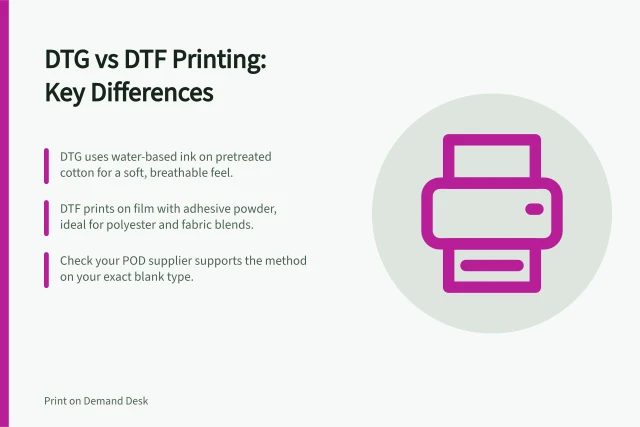
DTG applies ink directly to fabric. It is a candidate for detailed artwork on a supported cotton garment when a relatively soft print matters.
DTF prints the design on film and attaches it with heat. It can work on a wider range of supported fabrics. Check a representative garment before making claims about its feel or comfort.
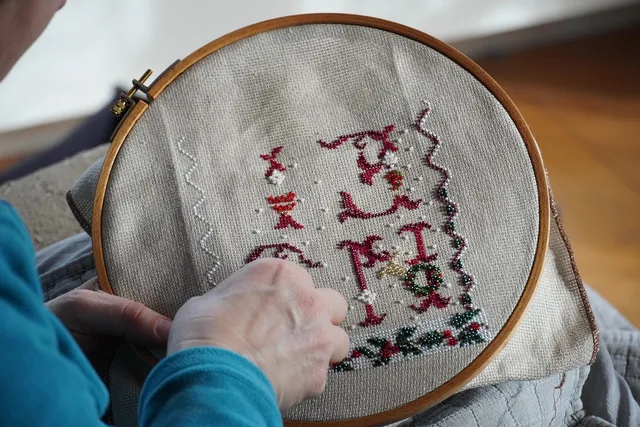
Embroidery makes a design with thread. Standard flat embroidery suits bold shapes better than photographs, shading or tiny lettering. Digitisation can enlarge or remove small details, and a digital preview may differ from the stitched item. Other embroidery techniques have different capabilities, so check the technique offered for the chosen product.
Printful describes its DTFlex process as printing artwork onto special film with water-based pigment inks, coating the print with adhesive powder, then curing the powder with heat. The transfer is heat-pressed onto the garment and removed using a cold peel after a few seconds.
Print-on-Demand Printing Guidelines (Australia)
- Colour Profile
- sRGB
- DTF Process
- Water-based pigment inks + adhesive powder + heat cure + cold peel
- Embroidery Limitation
- Fine details may be lost; digitisation alters small elements
Check what “all-over” means
An “all-over” label describes coverage, not necessarily the print method. Check the supplier’s product details to confirm the method and material.
Construction affects coverage. Check the product details for how the print is applied and where it may appear. Do not assume that one product’s process or coverage applies to another.
Paper posters follow a separate route. Printful describes printing its posters with water-based inks on paper, then cutting them to size. Choose the paper product and prepare a file for its format rather than applying apparel rules.
Prepare the poster file
Poster file settings can affect whether artwork fills the intended print area and retains detail. Printful advises checking the guidelines for the specific product, because wall art items can use different template sizes. Use a full-bleed image when the graphics need to cover the entire document.
For Printful poster files, use PNG for transparency or detailed graphics, or JPEG for simpler designs. Save in the sRGB colour profile, which Printful says helps the printed design look as it does on screen. Its stated minimum accepted resolution for paper products is 75 DPI, while 300 DPI is recommended for higher-quality results.
Upload the file in the orientation you want printed, either horizontal or vertical.
Decide for one product
Record the supplier product and variant, material, design size, required detail, preferred feel, print position and care information. Eliminate methods unavailable for that combination.
If the finish matters to the listing, inspect a representative item in ordinary light and by touch. One sample can reveal a mismatch; it cannot establish a defect rate or predict every future order.
Recheck the method when the blank, artwork or supplier changes.
In this guide
- Direct-to-garment versus direct-to-film printingCompare DTG and DTF by fabric, print feel, artwork and care before choosing a method for a specific POD garment.
- Embroidery versus printed decoration for apparelChoose stitched or printed apparel decoration using artwork detail, garment support, placement and finished feel.
- Choosing suitable products and designs for sublimationCheck material, coating, base colour, construction and care before choosing sublimation for POD apparel or mugs.
- Comparing print durability using sample testsCompare POD decoration samples under recorded care conditions and describe observed wear without claiming a universal durability winner.