
Supplier Selection
Print-on-demand supplier selection
Choose a POD supplier for an Australian offer by checking the exact product, fulfilment route, delivered supplier charge and required order features.
Choose a print-on-demand supplier based on the product you plan to sell and the customers you plan to serve. Start with the required variants and print areas, then compare the available fulfilment route, total supplier charge for an Australian delivery address and any order features your offer depends on.
Shortlist suppliers for one product
List the material or blank, sizes, colours, print areas and decoration method. Check each combination in the supplier’s catalogue. A product may be listed even when the variant or print area you need is unavailable on a suitable route.
Compare the same item and Australian destination across suppliers. Record the current product and shipping charges, the delivery information shown, and any branding requirements. Recheck those details before listing the product: catalogue availability, charges and routes can change.
| Check | Question to answer |
|---|---|
| Product | Are the required variants and print areas available? |
| Fulfilment | Where might an Australian order be produced, and can that change? |
| Customer offer | Do the available delivery and packaging options support what you intend to promise? |
| Cost | What is the supplier charge for the complete order and destination? |
| Problems | How can you report an order issue and request a remedy? |
Compare the supplier models
The documented models differ in where supplier choice and fulfilment uncertainty sit. Printful’s help topics distinguish fulfilment centres, whether you can choose where a product is fulfilled, and product availability statuses. Check those product-level details to understand what location choice and availability information apply to your item.
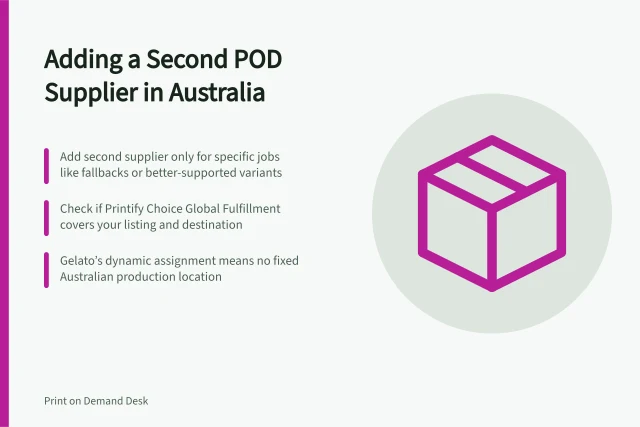
Printify’s documented options centre on comparing Print Providers, using multiple providers for a listing, and Printify Choice. Provider-level differences and the choice of provider model therefore matter; check the options for the exact product and variant before relying on them for an Australian order.
Gelato describes a network model: its system assigns a production location using product availability, delivery address and real-time capacity, among other factors. It does not currently display the exact location assigned to an order, and technical or logistical limits can move production elsewhere. Its Product Catalog shows product availability, so check it against the intended product and variant.
Print-on-Demand Supplier Fulfilment Models for Australian Orders
- Supplier
- Printful
- Fulfilment Centre Choice
- Limited – cannot choose location; fulfilment assigned by system
- Product Availability Status
- Explicitly stated (e.g., 'Available', 'Unavailable', 'In Production')
- Australian Production
- Not guaranteed – depends on regional fulfilment centres
Printify Provider Options and Multi-Provider Use
- Supplier
- Printify
- Multiple Providers per Listing
- Yes – can use multiple Print Providers for a single product listing
- Printify Choice
- Automated routing based on cost, speed, and location; no manual selection
- Australian Fulfilment Control
- Limited – relies on provider network; may not be localised
Set a decision threshold
Separate requirements a supplier must meet from preferences that can be traded off. For example, a required print area or variant is a pass-or-fail condition; a preferred fulfilment arrangement can be assessed among suppliers that pass.
For each shortlisted supplier, record whether the evidence confirms a requirement, makes it conditional, or leaves it unknown. A catalogue listing alone may not establish that the exact variant and print area can be fulfilled on the route relevant to an Australian order.
Decide in advance which unknowns are acceptable. If a requirement is essential, do not treat an undisclosed provider or production location as confirmation; either obtain a clear answer for the product or remove that option from the shortlist.
Choose from suppliers that meet the hard requirements, then compare the remaining options against your preferences. This keeps a convenient feature from outweighing a product limitation or an uncertainty that would prevent you from making an accurate customer offer.
Read capability evidence at product level
Gelato’s apparel production table lists Australia as supporting front and back printing, inner and outer labels, and short- and long-sleeve areas. That detail can help screen a clothing product when one of those areas is essential to the design.
Use a capability table to test the print area you actually need, rather than treating a country’s general apparel capability as proof for every product. Gelato notes that production capabilities differ between print partners and that technical or logistical limitations can affect where an order is made.
Gelato describes a network with local production in 32 countries and more than 140 print partners. Those figures indicate the scale of its network, not a guarantee that a particular variant will be produced in Australia; use product-level availability and the supplier’s stated limits to judge whether the model fits your offer.
Gelato’s Global Production Network for Australian Orders
- Countries with Local Production
- 32
- Number of Print Partners
- >140
- Australia Support: Front & Back Printing
- Yes
- Australia Support: Inner & Outer Labels
- Yes
Choose and recheck
Eliminate suppliers that cannot meet the product requirements. For those that remain, compare a current order for the same Australian destination. If branding or local production is essential, confirm what the supplier can support for that product and route before making a customer-facing promise.
Order a representative product if fit, print or packaging will affect the choice. Inspect that order as evidence of what arrived, while allowing for future orders to use a different route. Recheck the shortlist when you change the product, variant, decoration or destination.
In this guide
- Checking supplier support for order branding and packagingCheck whether a POD product and Australian order route support inserts, labels or custom packaging, including eligibility and fallbacks.