Pricing & Margins
POD product pricing
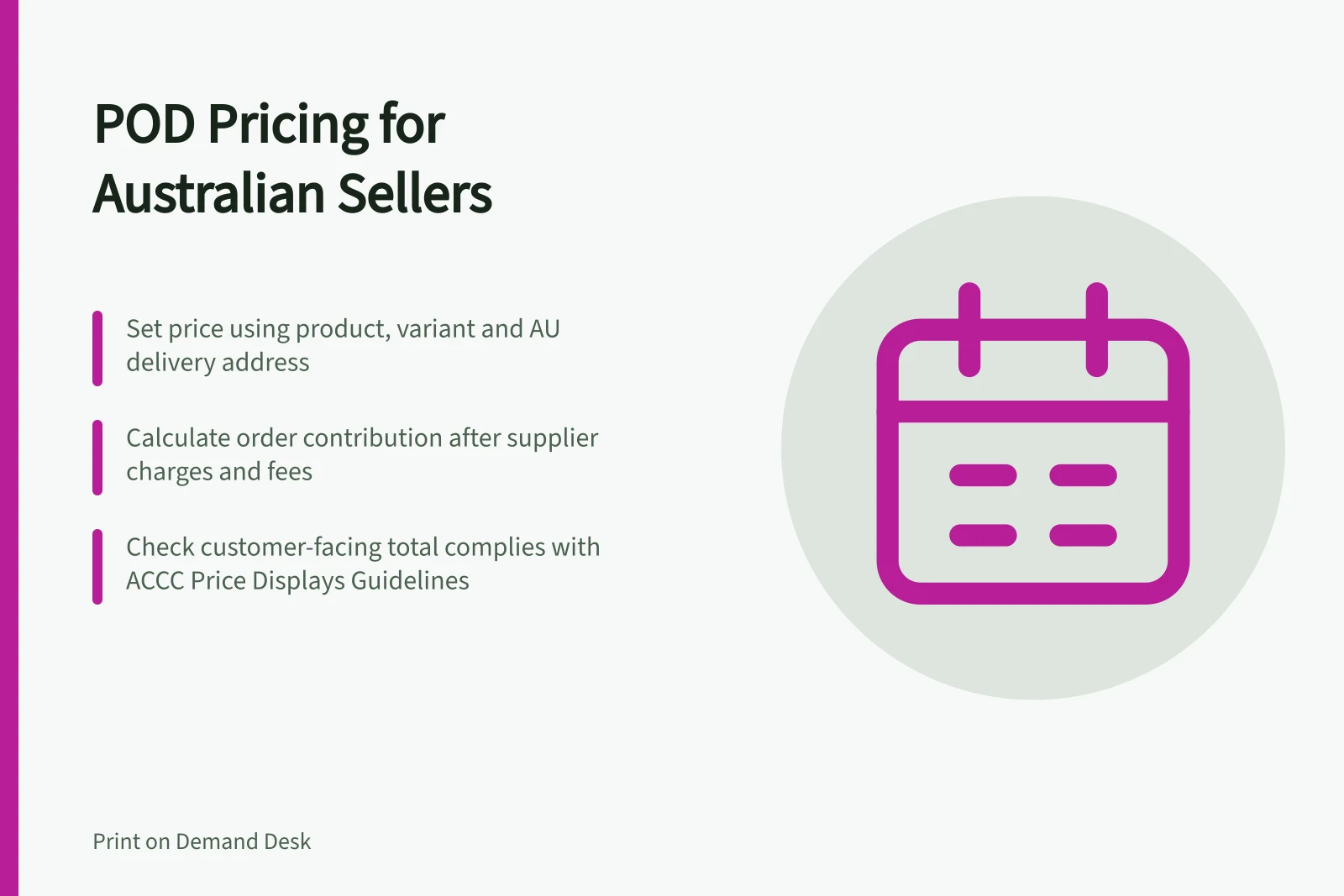
Set a POD product price using the full customer payment, printing, delivery, selling fees and an allowance for order problems.
Set a print-on-demand (POD) price from the complete order: what the customer pays, what fulfilling and selling that order costs, and what remains. Start with a defined product, variant and Australian delivery address, then check the total buyers will see. Recalculate when a variant, destination, supplier charge or promotion changes.
Price a defined order
Choose one product, variant and Australian delivery address. Record the current product and print charge, supplier delivery charge, applicable supplier taxes and selling fees, and include an allowance for order problems the store may have to fund.
Start with the customer payment after discounts: the item amount plus any delivery charge the customer pays. Subtract supplier product, print and delivery charges, applicable supplier taxes, selling costs and the problem allowance; what remains is the order contribution.
A simplified example puts a shirt’s selling price at $26 and subtracts $13 production, $4.75 POD shipping, $1.05 transaction fees, $7 advertising and $0.70 expected other costs, leaving a $0.50 loss per order. Treat it as an arithmetic illustration, not a target or price recommendation.
| Worksheet line | Question |
|---|---|
| Customer payment | What will the buyer pay for the item and delivery after discounts? |
| Supplier charge | What will this variant, print and destination cost? |
| Selling costs | Which marketplace, store and payment fees apply? |
| Problem allowance | What remedy costs is the store likely to retain? |
| Order contribution | What remains after these order-level costs? |
Choose a contribution target that reflects the expenses your orders must support beyond the order itself. The customer payment must cover the expected order-level costs and that target; if it does not, adjust the price or the offer.
Use amounts on a consistent GST basis and confirm the treatment that applies to your business. Order contribution helps cover design, support, marketing and other expenses beyond that order; it is not net profit.
Map how customer payments reach your sales channel and when fulfilment charges fall due. Check your own payment and payout timing so you can fund fulfilment when the supplier charges you.
Decide whether the price works
The price works against your chosen target when the order contribution meets or exceeds it after discounts and all expected order-level costs. Compare the proposed customer price with genuinely comparable products, including their product, print and delivery offer; a competitor’s lower price does not change your costs.
Check likely variants and destinations separately. A size may cost more to produce, and delivery can change with the basket and address. Recalculate after a discount and identify the lowest-contribution combination you intend to sell; you may need a different variant price or a narrower range.
Check the customer-facing price display across the buying journey, including when address and order details become known. The Australian Consumer Law, in the Competition and Consumer Act 2010, is the relevant price-display framework.
The ACCC’s Price displays guidance says a displayed total must include taxes, duties and all unavoidable or pre-selected extra fees. When promoting a component price, display the total as a single figure at least as prominently as that component.
Treat the displayed total as a compliance check, not just a conversion detail. The ACCC can investigate suspected breaches of price-display law and may take compliance or enforcement action. Reports help inform its education, compliance and enforcement work; it does not give businesses legal advice or resolve individual price-display disputes.
Check baskets and order problems
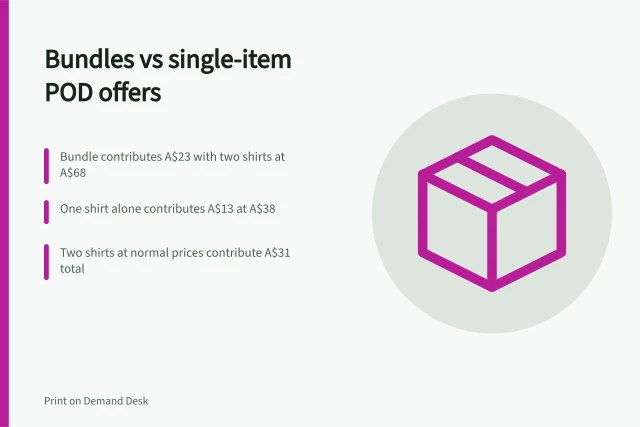
Check supplier charges for the actual basket before setting a bundle price or offering delivery at no extra charge. Verify the applicable shipping costs against your current supplier information.
Allow for the possibility that an order problem leads the store to incur additional costs. Track actual costs associated with complaints, replacements or refunds, and review the allowance in the price. Check applicable Australian consumer obligations and supplier terms separately.
Key pricing considerations for Australian POD sellers
- GST Compliance
- All displayed prices must include GST where applicable (ATO guidelines)
- ACCC Price Display Rule
- Total price must show all unavoidable fees and taxes upfront
- Shipping Cost Accuracy
- Check actual basket weights and dimensions; multiple items increase cost
Review the price after listing
Keep the product, variant, destination, supplier quote, selling fees, customer total, expected contribution and date checked together. Check the displayed checkout total before listing.
As orders arrive, compare the estimate with actual invoices, fees and remedy costs. Review whenever those inputs or the customer offer change, and update the price if the revised order contribution no longer meets your target.
In this guide
- Calculating margin after printing and deliveryCalculate a POD order’s contribution margin after product, print, delivery and selling costs with a hypothetical worked example.
- Comparing bundles with single-item POD offersCompare a POD bundle with one-item and normal-price basket sales using realistic delivery costs and order contribution.
- Accounting for replacements in a POD product priceEstimate a POD replacement allowance from unrecovered remedy costs while keeping supplier claims separate from Australian customer rights.