Pricing & Margins
Starting a print-on-demand business
A practical Australian starting path for a print-on-demand business: choose an offer, check production and costs, set customer expectations and launch carefully.
Begin with a specific buyer, one small product idea and a workable fulfilment route. Print-on-demand (POD) puts a design on a product made after the customer orders it, so you do not buy finished stock first. You must still check the product, set a viable price, explain delivery and help customers when something goes wrong.
Work through the decisions in order: define and test the offer, check production and per-order costs, set up the business and customer promise, then test the order path. Keep the first launch small enough to monitor and improve.
Define the first offer
Write down who the product is for, why they would want this design and where they would use it. “T-shirts for everyone” gives you little to test. A design for a particular interest or occasion gives you a clearer question to ask potential buyers.
Look at comparable products and speak to potential buyers beyond supportive friends. Ask what they would choose, what seems unclear and what price they would expect. Compliments are feedback, not proof of demand.
Keep the first range small enough to check each product and describe every variant accurately. Make sure you can explain what each option offers before you add it to a listing.
Test the idea with product-development steps
Make a basic version of the product that demonstrates the main idea. Put it in front of potential customers and ask what they like and what they would change. You can use surveys or interviews to gather honest feedback. Record the responses and use them to decide what to revise before moving on.
Choose a production route
For each proposed item, identify the blank product, print method, available variants, possible production locations, shipping route and how an order reaches the supplier. Check current product and file requirements before designing around a mock-up. A large supplier catalogue does not mean every variant suits your intended Australian customers.
Printful illustrates one route: it says it prints, packs and ships products after purchase while the seller connects a store and supplies designs. Check the exact products, destinations and order settings you need; other services may work differently.
Order a representative item before relying on its appearance in a listing. Compare the print, product and parcel with what buyers will be shown.
Printful reports that 99.76% of orders meet or exceed customer expectations and 99% customer quality satisfaction. The company says every product undergoes a three-step quality control and that it fulfils more than 1 million items every month.
Work out the money
Customer and supplier payments may be separate. Check how your sales platform and supplier handle payment timing, and make sure you can cover supplier charges in the meantime.
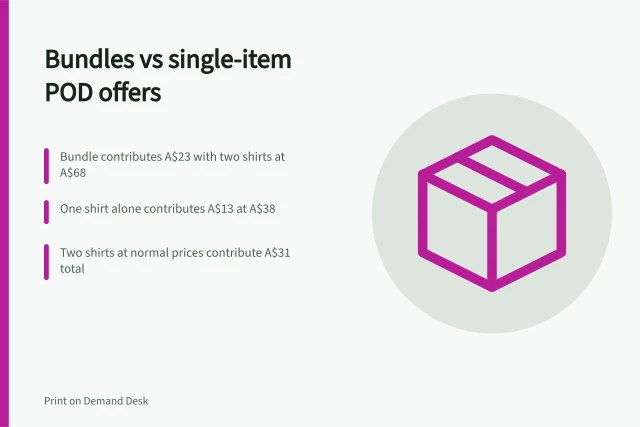
Build a per-order worksheet for the exact product and Australian delivery destination. Include production, supplier shipping, storefront and payment fees, applicable taxes, an allowance for service or replacements, and the cost of attracting a buyer. Compare those costs with the revenue the business retains, and check shipping costs for different order types separately.
POD avoids buying a finished batch for an unproven design, but that does not make every sale profitable. If the total cost will not support a credible price, revise the offer before listing it.
Set up the Australian business and customer promise
Check which business structure and registrations fit your circumstances. Australian Government guidance includes getting an ABN, registering a business name, protecting your brand with a trade mark, registering a company, registering for taxes, and getting the right licences and permits; which steps apply depends on your business. You can also get a domain name.
If you are considering a company, check the proposed company name against ASIC’s register before settling on it. Do not treat a name check as a substitute for confirming which registrations apply to your business.
GST is 10% on most goods, services and other items sold or consumed in Australia; registered businesses collect it on most sales and pay it to the ATO when due. For most businesses, registration is compulsory when GST turnover reaches $75,000, and a new business should register if it expects to reach that amount in its first year. GST turnover is business income, not profit. If you already have an ABN, register through ATO Online services for business within 21 days of becoming aware that turnover will exceed the threshold.
Decide where customers will order, then confirm that the chosen online store can connect to your supplier before building listings. A website and social media presence are other customer-facing steps to plan.
Confirm that you can use every design element commercially, including fonts and graphics. Search a proposed brand name, but do not treat a trade mark search as clearance on its own. Seek appropriate advice if a rights question remains.
Write listings from the products you can actually supply: variants, sizes or dimensions, material and care details where relevant, total price and a supported delivery estimate. Explain production time where it affects delivery. Check your obligations under Australian consumer guarantees.
The ACCC educates businesses and consumers about consumer guarantees and accepts reports about possible breaches and false or misleading claims. It uses reports to inform its education, compliance and enforcement work.
It can investigate misleading claims about consumer guarantee rights or other misleading claims. It may take compliance or enforcement action, and can require businesses to back up product or service claims.
The ACCC does not provide legal advice or resolve individual disputes about whether guarantees have been met, remedies, or misleading claims.
Launch a controlled order path
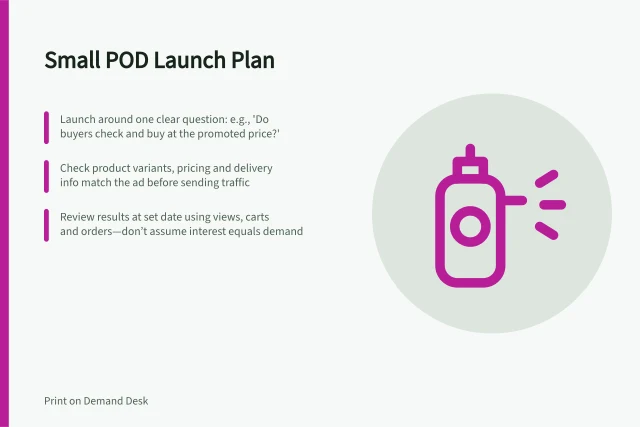
Before promoting the offer, inspect the listing and place an order through the sales path you intend customers to use. Check the selected variant, artwork, amount charged, supplier order and customer messages.
Start with a range you can support. Keep a record of orders, delivery questions, defects and reasons people decline to buy. Use what you learn to improve the offer before adding more products.
In this guide
- Print-on-demand versus holding finished stockCompare POD and finished stock by cash timing, unsold variants, order work and total costs before choosing a production model.
- Choosing a focused POD product rangeBuild a small POD launch range by checking buyer purpose, variants, file requirements, delivery and the work each product adds.
- Testing a design concept before building a full storeTest a POD design with a defined buyer question, honest mock-up, relevant feedback and a sample before investing in a larger store.