Design Preparation
Part of Starting a print-on-demand business
Choosing a focused POD product range
Build a small POD launch range by checking buyer purpose, variants, file requirements, delivery and the work each product adds.
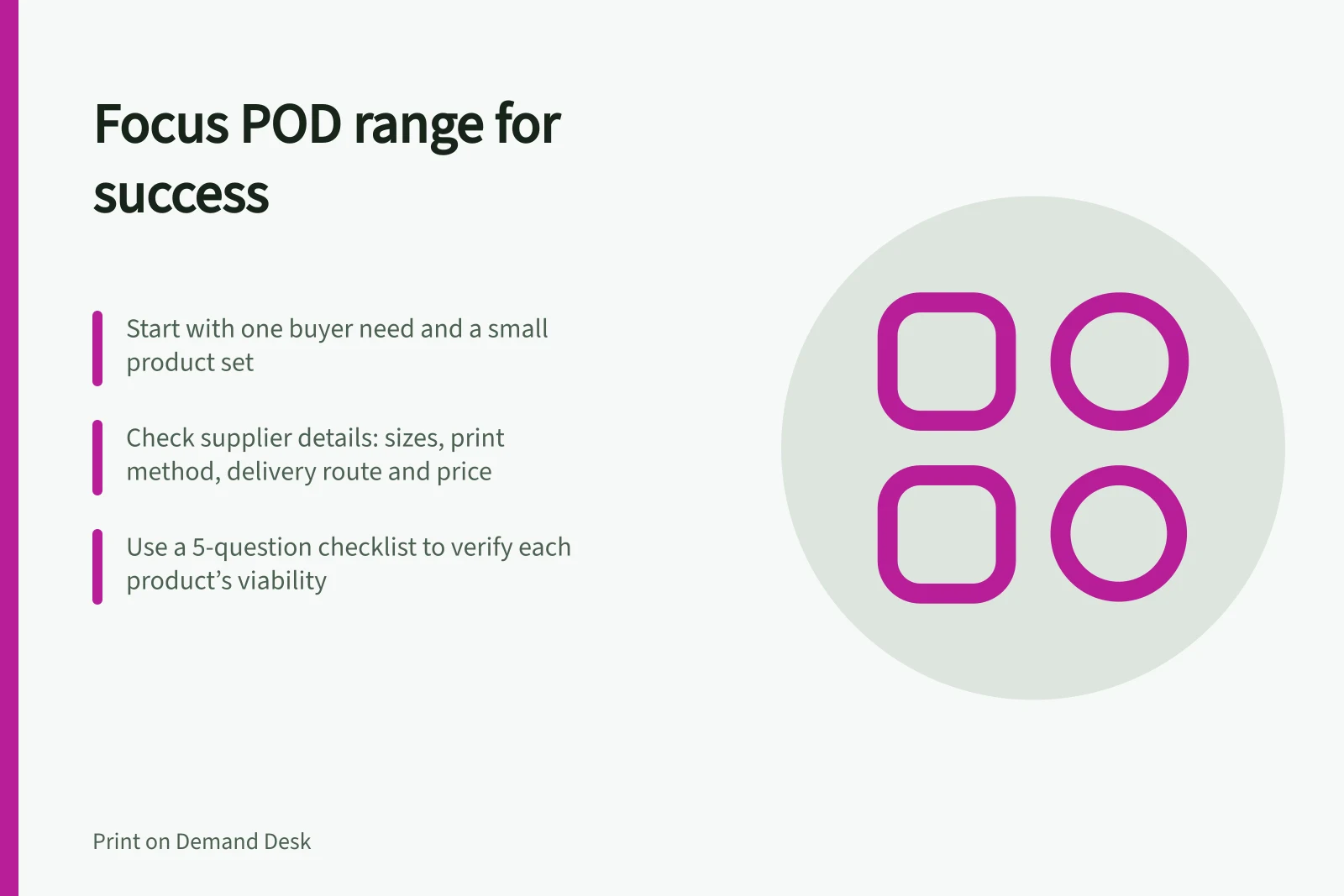
Build your first print-on-demand range around one buyer need and a few products you can check properly. A larger catalogue adds files, variants, descriptions and delivery promises to maintain. Ask which small set gives the buyer a clear choice?
Give each product a reason to be there
Describe the intended buyer and buying occasion in one sentence. Then give each candidate product a job. A shirt might suit a buyer who wants to wear the design; a poster might suit one who wants to display it. Include both only if each serves the buyer and you can verify its details.
For each candidate, record the exact supplier product, offered sizes or colours, print method, print area, delivery route and price you would need to charge. Check the current file guidelines for that product and use them when preparing the artwork.
Key Considerations for POD Product Selection
- Buyer Purpose
- Clear use or occasion (e.g., wear, display)
- Design Fit
- Print area, file guidelines, legibility at size
- Delivery Feasibility
- Shipping route, cost, delivery estimate
- Pricing Viability
- Full cost including GST, ABN, ATO-compliant margins
Use a short inclusion check
| Question | What to check |
|---|---|
| Why would this buyer choose it? | A clear use or occasion and feedback from potential buyers |
| Can the design work on it? | Current file requirements and a legible preview at the offered size |
| Can you describe it accurately? | Variants, materials or dimensions, care details and a representative sample where needed |
| Can you deliver it? | Current availability, route, shipping charge and supported estimate |
| Can the price work? | Full per-order costs for the intended destination |
Investigate unknowns before listing. A convincing mock-up cannot establish print quality or show exactly what will arrive in the parcel.
Launch Range Inclusion Check
- Why would this buyer choose it?A clear use or occasion and feedback from potential buyers
- Can the design work on it?Current file requirements and a legible preview at the offered size
- Can you describe it accurately?Variants, materials or dimensions, care details and a representative sample where needed
- Can you deliver it?Current availability, route, shipping charge and supported estimate
- Can the price work?Full per-order costs for the intended destination
Limit variants with a purpose
Every extra size, colour or format adds a customer choice and listing detail to check. Keep a variant when it serves the buyer and the design remains readable. Hold it back if its print contrast, file mapping or product specification is uncertain.
Check the shipping cost for an intended basket rather than assuming two items ship for the cost of one.
Approve the launch range
One product with a few justified variants, or a closely related pair with different uses, can be a manageable starting point. There is no proven ideal range size. Keep a record for each included item: supplier product, variants, artwork version, checked listing facts, sample status and review date.
Hold an item back if its buyer purpose is vague, its details cannot be confirmed or its price will not work. Add products when buyer questions and orders give you a reason to expand.
Approving Your Launch Product Range
- Start with one product or a closely related pairFocus on buyer purpose and clear use case
- Record key details for each itemSupplier product, variants, artwork version, checked listing facts, sample status, review date
- Hold back items with unclear buyer purposeIf details can’t be confirmed or pricing won’t work
- Expand only when buyer demand justifies itBased on customer questions and order patterns