Supplier Selection
Part of Starting a print-on-demand business
Print-on-demand versus holding finished stock
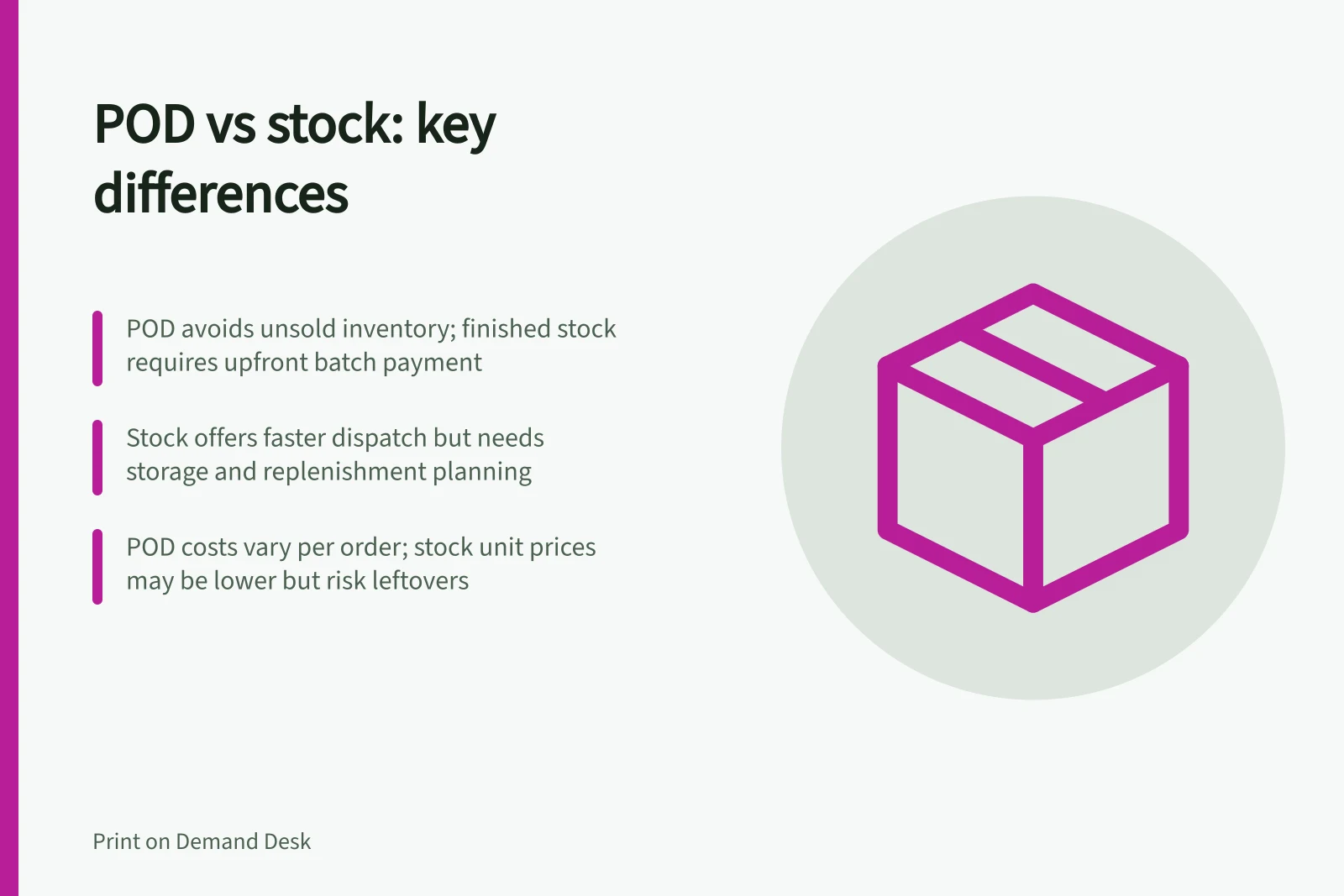
Compare POD and finished stock by cash timing, unsold variants, order work and total costs before choosing a production model.
Choose print-on-demand when demand for a design or variant is uncertain and avoiding unsold finished goods matters most. Consider holding finished stock when repeated sales justify buying a defined quantity and you can manage storage, dispatch and leftovers. Compare the same product and customer promise under both methods; neither is automatically cheaper or faster.
What changes when an order arrives?
With POD, the finished item is made after purchase. Printful asks sellers to configure billing to cover production costs and shipping. You still need a usable print file, an available variant and funds to cover the supplier charge.
With finished stock, the product has already been made. If you buy a batch, you pay for units before knowing which will sell. You then track quantities, returns and replenishment. Ready stock may give you control over dispatch, but delivery still depends on your packing process and shipping route.
| Decision point | POD | Finished stock |
|---|---|---|
| Cash for finished units | Per-order supplier charge in the described Printful model; setup and samples may cost extra | Batch purchase before sales |
| Unsold design or size risk | No finished batch of that design to clear | Remaining units may need storage, discounting or disposal |
| Order work | Check file, variant, production and supplier status | Track stock, pick, pack and dispatch |
| Product control | Depends on the provider’s blank and process | Depends on the batch specification and your checks |
| Replenishment | Check continuing product and variant availability | Plan reorder quantities and lead time |
A stock purchase may lower the unit price, but the comparison also needs to account for unsold units and the work of carrying them.
Compare a realistic sales period
Use the same product specification, selling price, destination and sales period for both options. For POD, record current product, print and shipping charges, storefront fees and other variable costs. For stock, record the full batch payment, inbound freight, storage, packing materials, outbound shipping and labour.
Keep cash and profit calculations separate. The full batch payment affects cash even if some units remain unsold. For a profit estimate, identify the cost of units sold and assess the remaining stock's likely value; do not add the value of leftovers as a second charge on top of the whole batch payment.
Test several demand levels and variant mixes. Fewer sales than expected may leave particular sizes or colours unsold even if the total forecast looked reasonable. The lowest quoted unit price is not necessarily the best choice when it requires a risky batch purchase.
Cash timing matters too. For POD, account for production and shipping costs; store payouts follow the store and payment provider's rules. A stock batch is paid for earlier. Map these payments rather than assuming customer receipts are immediately available.
Steps to Compare POD and Finished Stock Over a Sales Period
- Use identical product specs, selling price, destination and sales period for both options
- For POD, record product, print and shipping charges, storefront fees and variable costs
- For stock, record full batch payment, inbound freight, storage, packing materials, outbound shipping and labour
- Keep cash and profit calculations separatedon’t count unsold stock as revenue
- Test multiple demand levels and variant mixesavoid over-reliance on average forecasts
- Map payment timingPOD costs follow production and shipping; stock is paid upfront
Key Financial and Operational Metrics for Decision-Making
- POD Production Cost (per unit)
- Varies by product and region — check Printful's pricing page
- Stock Batch Payment (upfront)
- Full cost of purchased units before any sales
- Storage Cost (monthly)
- Estimated at $1–$3 per item depending on warehouse type and location
Decide which route fits
POD can help you trial a design when its demand and variant mix are uncertain. Stock may become attractive when sales are steadier, the specification is stable and a realistic batch comparison works after storage and leftovers. You can also hold a proven item while keeping uncertain designs on demand. Describe each item's production and delivery route accurately to customers.
Keep records of stock on hand, sales and returns, and update them regularly to identify what sells and avoid over-ordering. Back up product claims you make.
Pros and Cons of Print-on-Demand vs Holding Finished Stock
- Print-on-Demand – ProsLow risk of unsold inventory; ideal for testing new designs; no upfront bulk payment; flexible variant management
- Print-on-Demand – ConsHigher per-unit cost than bulk purchase; longer delivery times due to production delay; less control over quality consistency
- Holding Finished Stock – ProsLower per-unit cost with bulk buying; faster dispatch; better control over packaging and branding; potential for higher margins
- Holding Finished Stock – ConsUpfront capital outlay; risk of unsold stock; storage and handling costs; potential for obsolescence or discounting