Supplier Selection
Part of POD intellectual property checks
Handling a suspected copy of a POD design
Preserve a suspected copy, check your rights and compare the relevant work before contacting a seller or filing a platform report.
When another seller appears to use your POD design, preserve the listing, compare the work and check which rights you can assert before reporting it. In Australia, the concern may be copyright in original artwork or a trade mark used as branding; similarity alone does not establish infringement.
Preserve the comparison
Record the suspected listing’s address, seller, product, images and the date you saw it. Keep screenshots showing the design and listing details, alongside your source files, dated development records, publication history and any relevant contracts or licences.
Compare the specific features that concern you. Mark which came from your own work and which came from stock art, a common template or another supplied source; a shared licensed element or common idea may explain some similarity.
The Copyright Act 1968 (Cth) covers original artistic works and protects expression rather than ideas, information or concepts. An original work must originate with an author and not be a copy, so assess the particular expression rather than claiming rights over a general theme.
Check who can act
Australian copyright is automatic: there is no need to register it. The creator is generally the copyright owner, but a written agreement can change ownership; a creator may have licensed the artwork rather than assigned it, and a library graphic may be licensed to other users. Check the relevant agreement and the licence’s scope before claiming exclusive rights.
Copyright in artwork and a trade mark used as branding are different rights. If the concern is a brand identifier, consider whether it involves a trade mark, including an unregistered trade mark; IP Australia First Response has guidance titled “Unregistered trade marks”.
Check that you own the relevant right or are authorised to report it, and that the suspected listing uses the protected work or branding you have identified. A physical product sale does not automatically transfer copyright, and a licence may permit another seller to use an element.
Copyright vs. Trade Mark: What rights apply?
- CopyrightProtects original artistic expression (e.g., unique artwork). Automatic in Australia; no registration needed. Covers visual design elements.
- Trade MarkProtects brand identifiers like logos, names or slogans used in commerce. Can be registered or unregistered. Protects branding, not design style.
Key facts about Australian IP rights
- Copyright ownership
- Automatic upon creation. Creator is usually owner unless assigned in writing.
- Registration not required
- Australian copyright does not require registration. Protection begins at creation.
- Unregistered trade marks
- Can still be protected if used in commerce and recognised by consumers.
Choose a response route
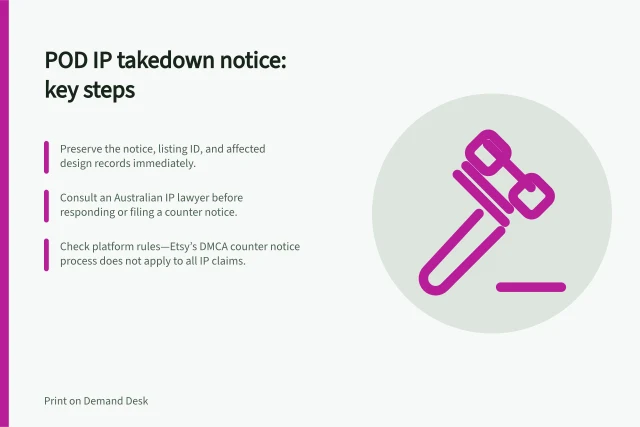
You can contact the seller with a factual account of the work and listing, explain the concern and ask for a response. Preserve your evidence first, and avoid presenting an untested conclusion as proven; consider qualified advice if the dispute is significant.
For Etsy, use its “How to Report Intellectual Property Infringement” guidance and follow the current reporting process. For Shopify, use “Reporting copyright infringement or responding to a copyright notice” and follow its current process and live form.
Keep any reply and reassess the evidence, including a licence or independent creation record the other seller provides. Record the outcome—no action, correction, removal or agreement—and describe the matter as suspected unless the evidence supports a stronger conclusion. A platform removal is a procedural outcome, not a court finding.
Steps to handle a suspected POD design copy
- Preserve evidenceTake screenshots of the suspected listing, including URL, seller, product, images and date seen. Keep your source files, development records and relevant contracts.
- Compare the designsIdentify which elements are from your work, stock art or common templates. Note that similarity in ideas or themes does not constitute infringement.
- Choose a response pathContact the seller with facts, or report via Etsy’s IP reporting process or Shopify’s copyright policy. Avoid presenting unproven claims as facts.
- Review outcomesRecord any reply, correction, removal or agreement. Treat platform actions as procedural, not legal findings.